
How to use and evaluate “Cozy Romantic Couple Mirror Selfie”
This couple prompt is designed as an editable starting point, not a guaranteed one-click result. The notes below translate its JSON into a readable visual plan, identify the controls that matter, and show how to diagnose a weak generation without simply adding more text.
Prompt-specific blueprint
Scene and atmosphere
- Location
- a warm cozy bedroom with a beige wall covered in framed couple photographs, delicate string lights arranged around the frames, a wooden cabinet with books and small decorative objects, and a glowing table lamp
- Time
- warm indoor ambient setting
- Mood
- romantic, intimate, affectionate, cozy, candid, warm, natural, and emotionally genuine
Visual treatment
- Photography
- ultra-realistic candid mirror-selfie photography with authentic skin texture, natural facial detail, realistic hair, realistic clothing texture, believable mirror reflection, genuine smartphone-camera character, subtle photographic imperfections, and no artificial or overly polished AI appearance
- Camera
- vertical 9:16 full-body to three-quarter mirror selfie composition, natural smartphone perspective, realistic mirror geometry and reflection, subjects framed naturally together, shallow depth of field, believable perspective and proportions
- Lighting
- soft warm ambient bedroom lighting combining the glowing table lamp and delicate string lights, with natural highlights and shadows across both faces, hair, clothing, bodies, smartphone, and surrounding environment; facial lighting must remain physically consistent with the rest of the photograph
Composition and wardrobe
- People Count Label
- two uploaded reference people
- People Count
- couple
- Reference Instruction
- Use the uploaded reference image(s) as the exclusive identity source for both people. The man stands on the right and the woman stands close beside him on the left. The man holds a smartphone in his right hand at chest level while naturally looking down toward the woman with a soft affectionate s…
- Wardrobe · Man
- A loose white vertically striped button-up shirt with the sleeves naturally rolled up, black trousers, a silver wristwatch, and keys clipped at his waist.
- Wardrobe · Woman
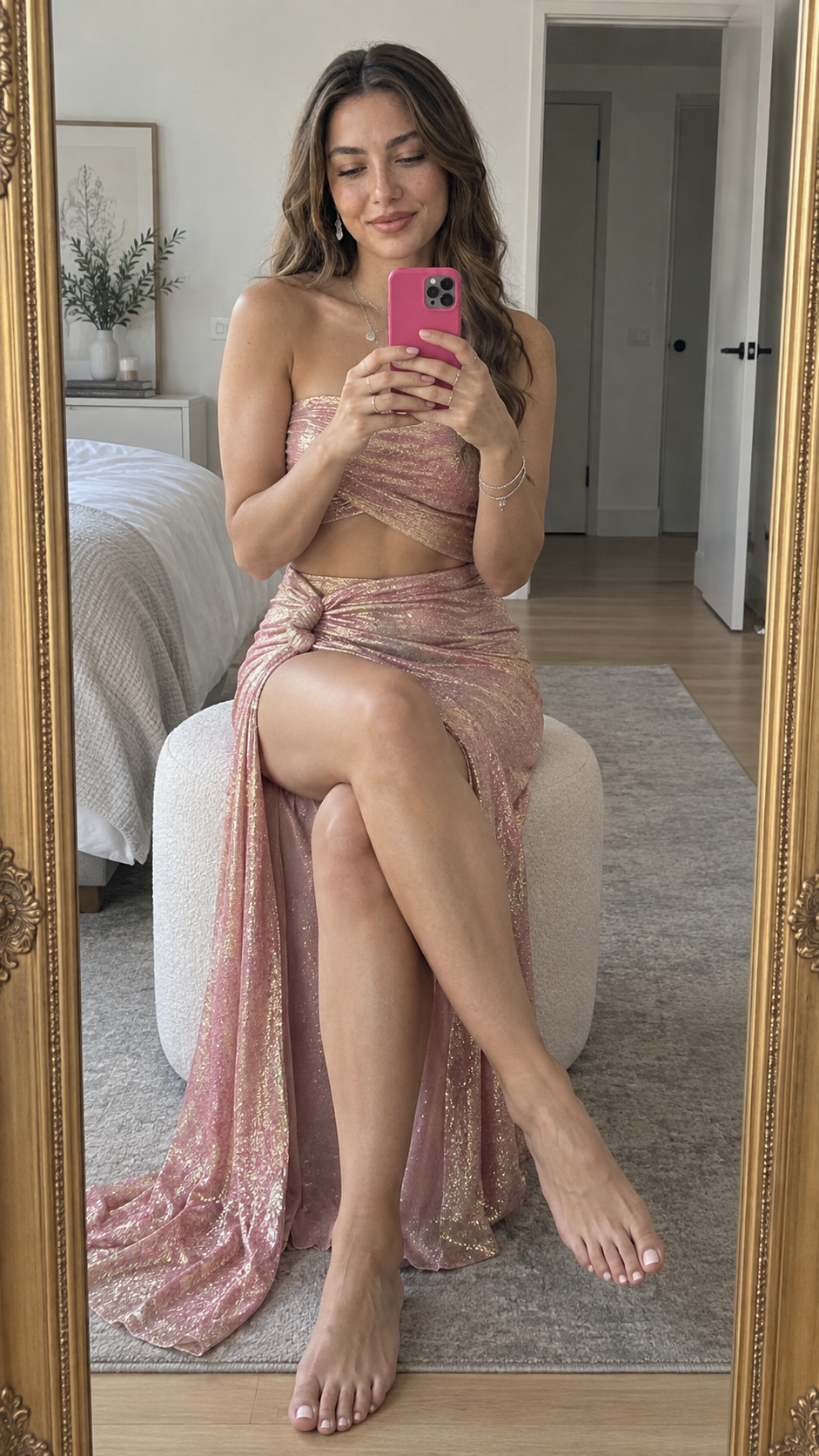
- A cream puff-sleeve blouse, a long black skirt with small bow details and a decorative belt, plus a delicate floral headband.
Recommended workflow
- 01
Prepare the input
Choose reference images you have permission to use. For Cozy Romantic Couple Mirror Selfie, prioritize a clear subject and avoid unrelated people or private details in the frame.
- 02
Lock the visual plan
Confirm subject count, framing, scene, and lighting before adding finishing language. Resolve conflicts such as close-up versus full-body composition.
- 03
Adapt for one model
Start with ChatGPT Image. Keep a baseline generation and document the exact model version, references, aspect ratio, and visible settings.
- 04
Revise from evidence
Name the visible failure, change one instruction block, and compare it against the baseline. Keep only revisions that improve the intended criterion.
Model adaptation notes
ChatGPT Image
Keep the JSON structure, attach references in the same conversation, and use follow-up edits for one local correction at a time.
Gemini
Provide the JSON with clearly labeled reference images. Restate any ignored constraint in plain language without duplicating the whole prompt.
A compatibility label means the visual intent can be adapted; it does not promise identical output across providers, versions, or settings.
Prompt-specific quality checklist
- Preserve the exact hair identity of each referenced person, including natural hair color, hair length, density, texture, naturally straight, wavy, or curly pattern, hairline, characteristic parting, overall volume, and recognizable silhouette.
- The man's hair must remain consistent with his referenced hair identity while naturally accommodating the requested tousled curly appearance. Do not replace his natural hair characteristics with a generic hairstyle.
- The woman's hair must preserve her referenced hair color, length, density, texture, hairline, and recognizable hair identity while naturally accommodating the requested long straight appearance and floral headband.
- Do not freeze the exact placement of individual hair strands from the reference images. Naturally adapt hair placement, face-framing strands, volume, direction, gravity, overlap, compression, and subtle movement to each subject's new head angle, interaction, environment, and pose.
- Preserve each subject's natural body type and realistic body proportions from the uploaded reference images. Do not intentionally make either person slimmer, curvier, more muscular, more athletic, taller, broader, more conventionally attractive, or sexually exaggerated unless explicitly requested by the original prompt.
- If a subject is naturally slim, average, fit, muscular, broad, or heavier in the reference, preserve that body character faithfully. Clothing must follow the resulting natural anatomy instead of reshaping the body toward an idealized physique.
- If the body is not sufficiently visible in a reference image, infer a plausible natural body structure conservatively from the visible head, neck, shoulders, age, proportions, and overall identity cues rather than defaulting to an idealized fashion-model, muscular, or sexualized body.
Failures to check before publishing
- identity drift
- altered facial anatomy
- generic face
- beautified face
- idealized facial proportions
- pasted face
- copied face pose
Why the editable controls matter
Gender
Required identity direction for the reference subject.
People count
Default is a single uploaded reference person.
Identity or subject drift
Reduce competing style language, improve the reference, and separate stable traits from pose, gaze, and expression.
Composition breaks
Check whether crop, shot distance, aspect ratio, subject count, and required objects can all be satisfied in one frame.
Artificial lighting or texture
Name a motivated light source and believable material behavior before adding grain, grading, sharpness, or resolution terms.
 @cankirkgoz
Comments
Share the result you got, attach an image, and reply to other people's results.
You need to sign in to comment.